Running the world *together* with the US?
The historical origins of Russia's resentment (from newly declassified documents).

Among recently declassified documents on the post-Cold War history of US-Russia relations, there is one that really stands out. It’s the thirty-page long discussion between Russian Foreign Minister Andrei Kozyrev and U.S. Secretary of State Warren Christopher. The meeting took place on March 15, 1994 in Vladivostok, in the Russian Far East. It provides unique insights into Moscow’s expectations of the post-Cold War world, as well as early signs of frustrations and resentment that would soon boil over into the kind of revisionism we have come to associate with Putin.
Warren Christopher was in Vladivostok just briefly as part of a longer Asia tour that took him to Australia, Japan, and China. The meeting with Kozyrev was very brief. He didn’t even leave the airport. And it began, unpromisingly, with Kozyrev telling Christopher that he had a long statement to make, and asking whether Christopher wanted to hear it all at once or in parts. Christopher told him to do as he liked.
The Russian Foreign Minister then made a lengthy, somewhat rambling presentation, which was evidently accompanied by a draft document (we don’t yet have the document). The essence of the charge was that the United States was not treating Russia as an equal, and if continued in this fashion, things would not turn out well. Let’s highlight a few passages.

“We believe,” Kozyrev said, that “the relationship [between Moscow and Washington] can and must be only one of equality and total dialogue.” He followed with this eye-popper:
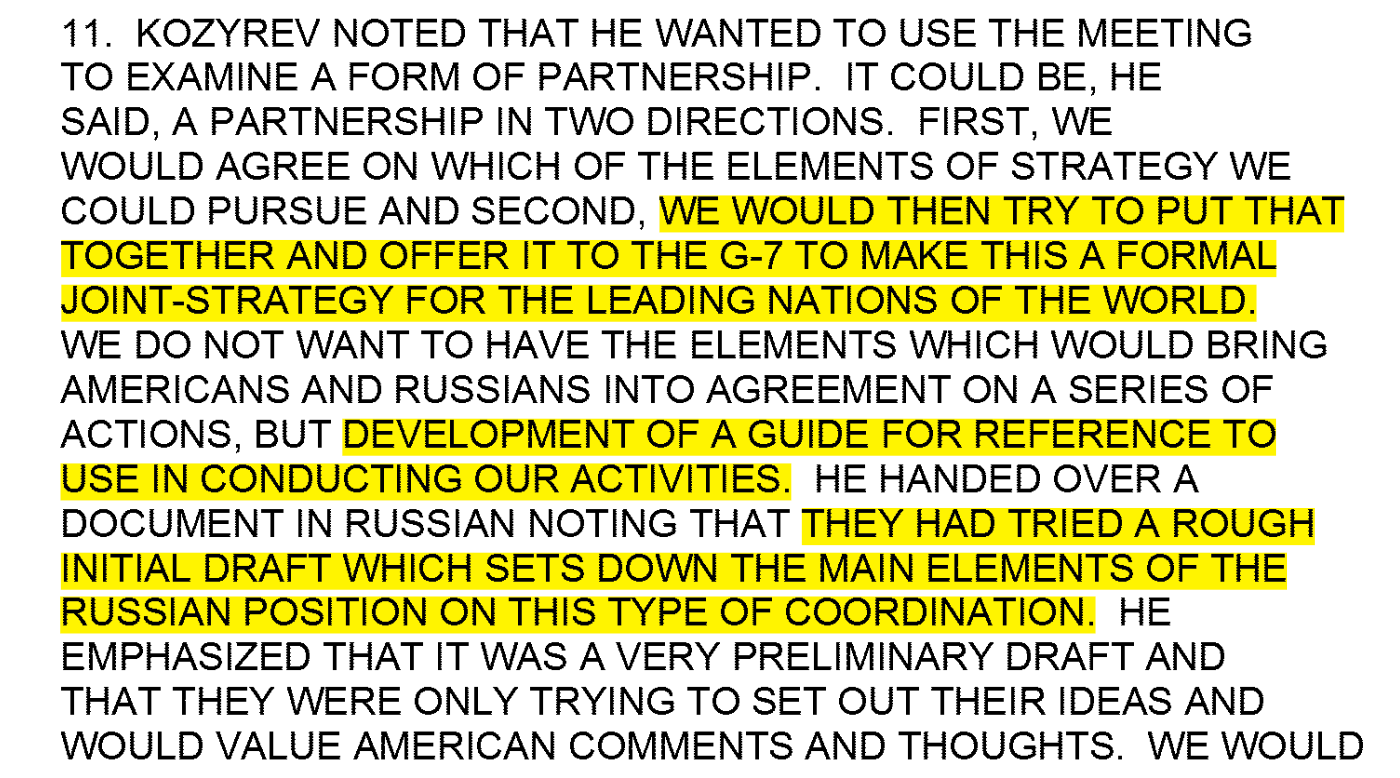
Just to clarify, he was proposing to develop a joint Russian-American “strategy” that would then be presented to the G7 “as a guide for reference to use in conducting our activities.” He talked about “coordination,” which presumably referred to Russia and the U.S. deferring to each other and acting jointly to manage certain international problems.
The underlying idea here by the way was exactly one that Leonid Brezhnev presented to Richard Nixon in the early 1970s, a form of a “condominium.” Now, the earlier condominium failed in part because the relationship between the two superpowers was, fundamentally, one of strategic competition. What Kozyrev was implying here is that now that the Cold War was over, Russia and the United States were no longer in competition. Therefore, they could work together if only each respected the other’s legitimate interests. And this is where it gets really interesting.

Kozyrev argued that the U.S. was not respecting Russia’s interests in the Commonwealth of Independent States (CIS), regarding Moscow’s activities there with “suspicion.” And when certain CIS countries complained to the Americans about Russia’s behavior, the United States, would you believe it…
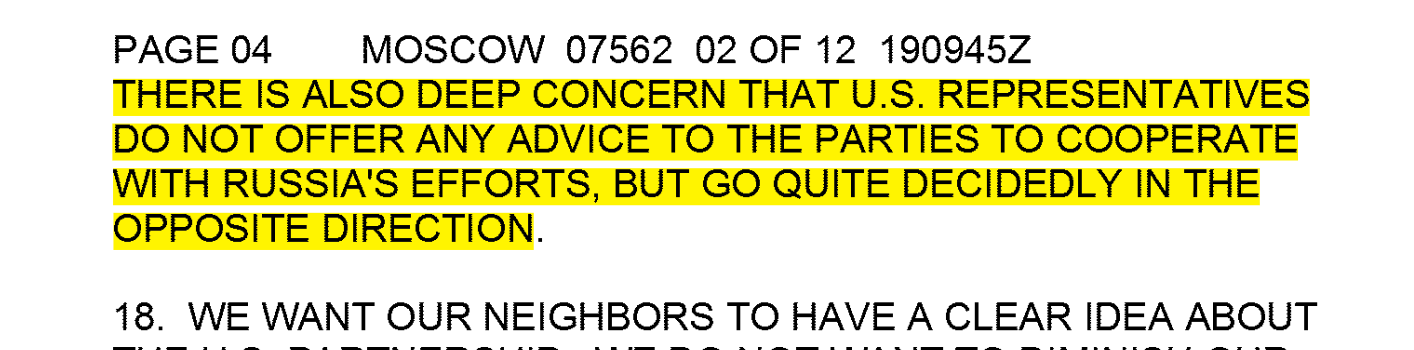
…failed to convince these countries that Russia was acting in their own best interest.
Keep reading with a 7-day free trial
Subscribe to Sergey Radchenko to keep reading this post and get 7 days of free access to the full post archives.